loader
Air freight is suitable when speed, tight deadlines, and cargo safety are priorities. This format is especially useful for urgent shipments, high-value goods, and cargo with special storage requirements.

Routes

View air freight routes

Find in catalog


Carriers

Find an air
freight carrier

Find in catalog

Key aspects of air freight

  • Deadlines

    Depend on flights, terminals, and shipment type (direct or transit).

  • Limitations

    Dimensions, weight, DG, batteries, and temperature requirements.

  • Documents

    Invoice, packing list, goods description, and AWB.

  • Suitability

    Urgent, valuable, temperature-sensitive, fragile, and regular small shipments.

How air cargo transportation works

Air freight is all about speed and restrictions. Main risks are not related to the flight itself, but to cargo clearance, flight space availability, and terminal handling.

01.

Data collection and feasibility check

Cargo parameters, deadlines, and origin/destination points are determined. Shipment feasibility is checked considering restrictions for dangerous goods, batteries, liquids, and requirements for packaging and labeling.

02.

Choosing route and transportation format

Airports, flights (direct or transit), shipment format (consolidation or individual shipment), and the need for first/last mile services are selected.

03.

Planning and space booking

Departure dates, space availability, cargo acceptance terms, and cut-offs are agreed upon. The possibility of shipping on time depends directly on having confirmed space.

04.

Cargo acceptance and documentation

Cargo is accepted at the terminal: weighing, checking packaging and labeling, and additional inspections if necessary. AWB is issued, and cargo is cleared for departure.

05.

Transportation, arrival, and delivery

Cargo follows the route with possible transit, undergoes terminal handling upon arrival, and is released to the consignee. Door-to-door delivery and final documents can be organized if required.
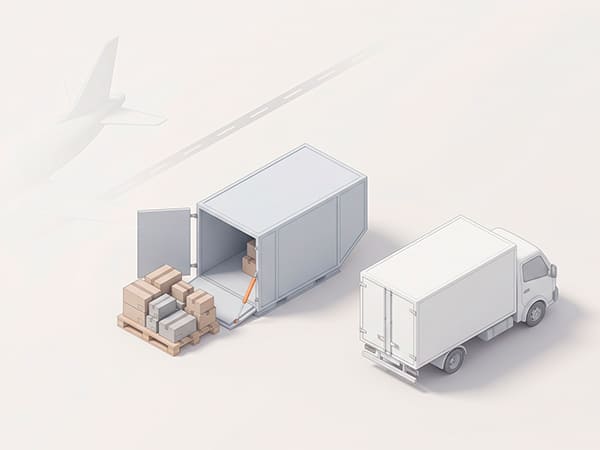
Air delivery options

It is important to distinguish between "how it travels" and "what is included." In air freight, the same flight can be organized under different service formats.

Airport-to-Airport

Suitable for: those who can deliver cargo to the departure airport and pick it up at the destination airport themselves.
What is included: air leg and standard terminal handling.
Where delays occur: dropping off after cut-off, non-compliant packaging or labeling, additional inspections.

Door-to-Airport

Suitable for: those who need to organize the first mile but plan to pick up from the airport.
What is included: cargo pickup, delivery to the terminal, and air transportation.
Where delays occur: cargo not ready for pickup, errors in weight/dimension data, terminal delays.

Airport-to-Door

Suitable for: those who drop off cargo at the airport but need delivery to the consignee.
What is included: air transportation, pickup at destination, and delivery to the address.
Where delays occur: terminal pickup, verification of consignee documents, and delivery time restrictions.

Door-to-Door

Suitable for: those who need a single point of responsibility and minimal operational involvement.
What is included: pickup, terminal handling, air transportation, and final delivery.
Where delays occur: coordination between transport participants, flight waiting times, and documentary issues.

Consolidation / Groupage air freight

Suitable for: small shipments when there is no need for a dedicated shipment.
What is included: acceptance at a consolidation warehouse, batch combining, and further air transport.
Where delays occur: waiting to complete the batch and additional warehouse operations.

Documents and data for processing

Basic document package

  • Commercial Invoice (value, name, country of origin if necessary)
  • Packing List (number of pieces, gross/net weight, dimensions)
  • Description of goods in simple and clear terms
  • Contact details of the sender and receiver
  • AWB (Air Waybill) — issued during the shipping process

Additional, depending on cargo type

  • MSDS / Safety Data Sheet for chemical products and potentially dangerous goods
  • Confirmations for batteries (type, power, packaging, and labeling)
  • Temperature instructions and packaging requirements
  • Certificates and permits for regulated goods categories

What data is needed for correct processing

  • Number of pieces and precise dimensions for each piece
  • Actual weight and distribution by cargo piece
  • Requirements for temperature, fragility, and orientation restrictions
  • Shipping urgency and critical delivery dates
  • Delivery requirements and documents needed by the consignee

What cargo is shipped by air and what restrictions are important

General cargo

What is important: correct dimensions, sturdy packaging, and clear goods description.
Risk: terminal delay due to discrepancies between actual and declared data.

Valuable cargo

What is important: access control, security procedures, and minimizing handling.
Risk: additional inspections and document requirements.

Dangerous goods (DG)

What is important: classification, packaging, labeling, and a complete set of documents.
Risk: refusal of acceptance upon any non-compliance.

Temperature-sensitive cargo

What is important: thermal packaging, handling instructions, and route planning.
Risk: temperature excursion during terminal waiting time.

Urgent cargo

What is important: meeting cut-offs, flight space availability, and document readiness.
Risk: shipping delay during high airline capacity utilization.

Fragile and sensitive cargo

What is important: reinforced packaging, labeling, and handling protection.
Risk: damage due to insufficient terminal protection.

Cargo with batteries and electronics

What is important: compliance with lithium battery shipping rules and correct labeling.
Risk: delay or refusal due to incorrect battery declaration.

Packaging, labeling, and preparation

Proper cargo preparation is one of the most effective ways to avoid delays and problems in air freight.

Typical requirements:
  • Packaging must withstand terminal handling, movement, and stacking
  • Containers must be securely closed to prevent spontaneous opening
  • Labels must contain sender and receiver data, and piece count
  • Special instructions and packaging solutions must be used for fragile and temperature-sensitive cargo
  • Documents must match actual cargo data
Common mistakes:
  • Dimensions and weight estimated rather than actual
  • Discrepancies between packing list and actual number of pieces
  • Presence of batteries or hazardous components not specified in documents

What affects air delivery times

Air freight is fast, but the total time consists of several stages. Most delays happen not in the air, but on the ground — during cargo handling, space booking, and terminal processing.

Key factors:
  • Direct flight or transit via a hub
  • Flight frequency on the route and seasonal load
  • Drop-off time relative to terminal cut-off
  • Cargo category (DG, temperature-sensitive, valuable) and additional procedures
  • Document readiness and data accuracy
  • Terminal handling upon arrival and delivery rules

Practical conclusion: if deadlines are critical, it is most important to prepare documents in advance and drop off the cargo with a time buffer before departure.

What affects air freight costs

Cost is influenced not only by cargo weight but also by volume, product category, chosen service, and handling requirements.

Main factors:
  • Actual weight and volumetric weight of the cargo
  • Service scheme: airport-to-airport or door-to-door delivery
  • Direct flight or transit route
  • Cargo category (DG, temperature-sensitive, valuable, fragile)
  • Seasonality and airline load levels
  • Additional services: cargo pickup, delivery, insurance, storage, re-packaging

Risks and how to mitigate them

Main problem areas
  • Terminal acceptance: non-compliance of packaging, labeling, or cargo data
  • Space booking: high flight load and airline restrictions
  • Transit shipments: waiting for connecting flights and schedule changes
  • Special cargo categories: DG, batteries, and temperature-sensitive goods require full compliance with requirements
  • Arrival release: documents, terminal procedures, and cargo pickup organization
What really helps
  • Provide exact dimensions and weight for each cargo piece
  • Check cargo category restrictions in advance, especially for batteries and DG
  • Drop off cargo before cut-off with a time buffer
  • Use clear control statuses along the entire route
  • Agree on the format and frequency of shipping updates

How to choose an air freight carrier

A good air freight contractor is not just about cost; it is about the ability to predictably deliver cargo without surprises, adhering to requirements for deadlines, documents, and restrictions.

Selection criteria:
  • Proven experience with your cargo category (DG, temperature-sensitive, valuable, electronics)
  • Competent document handling and data verification before terminal drop-off
  • Clear status tracking and communication system throughout the shipping process
  • Transparent liability and insurance terms
  • Practical experience with necessary airports, terminals, and agency networks

FAQ

AWB (Air Waybill) is an air transport document. It is the primary transport document used to accept, transport, and release cargo to the consignee.

In air freight, cost and space availability often depend on volumetric weight. If dimensions are not accurate, the terminal will recalculate them, which can affect the shipment.

Yes, but requirements depend on battery type, packaging, and airline rules. Errors in battery declaration are one of the most common causes of delays.

No. Many dangerous goods categories are shipped by air when requirements for classification, packaging, labeling, and documentation are met.

Delays are most often related to document errors, non-compliance in packaging and labeling, late cargo drop-off, transit connections, and high flight loads.

Yes. This is achieved through special packaging solutions, temperature instructions, and terminal handling control. Minimizing cargo waiting time is especially important.

If the cargo value or potential damage is significant, insurance is usually justified. However, insurance does not replace quality packaging and correct documentation.

Control is built on shipping statuses: received at terminal → processed → loaded → departed → arrived → ready for release. It is important to agree on the update format in advance.

Proceed to option selection

First, determine cargo restrictions and the service format (airport-to-airport or door-to-door), then compare options and submit a request.