
 English
 Русский
 Español
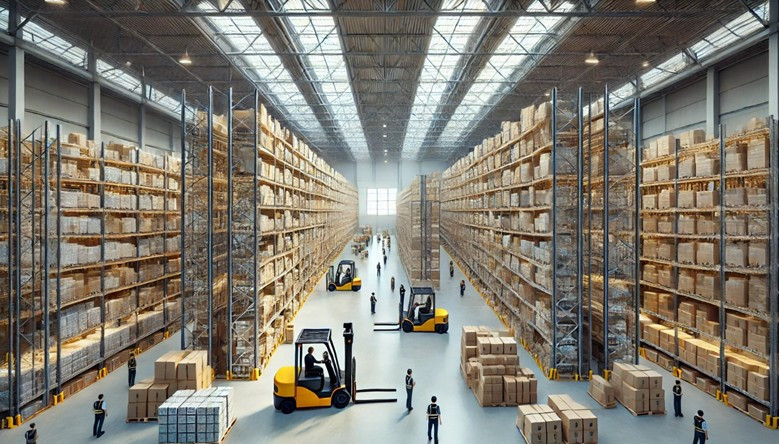
For logistics directors, owners and senior executives, Uzbekistan is now one of the most dynamic warehouse real estate markets in the region. By 2024, the country had become a regional leader among Central Asian and South Caucasus states in terms of warehouse infrastructure growth: within a single season, the volume of modern warehouse space doubled and exceeded 500,000 square meters.
At the same time, the structural shortage remains. According to expert estimates, to reach a level of provision comparable with neighboring countries, an additional 2.3–2.4 million square meters of warehouse space must be built. For logistics and business, this means not only rising rental costs but also a window of opportunity for those who are ready to systematically invest in infrastructure and management solutions now.
Rapid development of logistics infrastructure
New logistics centers and warehouse facilities
In 2024, several large logistics centers and warehouse complexes were commissioned in Uzbekistan, forming the foundation of the future market:
- the Grand Pharm logistics center in the Zangiata district (Tashkent Pharmaceutical Park);
- a warehouse complex with an area of 50,000 square meters in the Yangiyul district of Tashkent region;
- a warehouse complex of Orient Logistics with an area of 21,500 square meters;
- a warehouse complex of Balton Trading Asia with an area of 20,000 square meters.
These facilities increase overall market capacity, shorten delivery distances to key consumer centers and set the benchmark for the quality of storage, cross-docking and order-processing services.
For management. The emergence of new logistics centers gives you an opportunity to rethink your network design: consolidate warehouse nodes, reduce the number of scattered sites, improve delivery SLAs and lower operating costs by concentrating flows.
Challenges and prospects for the warehouse segment
Despite the growth in newly commissioned space, the market remains under-supplied. There is only 0.01 square meter of modern warehouse space per capita in Uzbekistan. This leads to intense competition for contemporary facilities and makes businesses highly sensitive to warehouse location and format.
To reach the level of Kazakhstan and other regional leaders, Uzbekistan needs to build at least 2.8–2.9 million square meters of warehouse space. Given real investment cycles and project implementation speeds, this volume will require at least 7–8 years.
For logistics professionals. The infrastructure gap makes capacity planning, warehouse class selection and the format of cooperation with landlords critical decisions. Mistakes in these areas directly affect last-mile costs, service levels and inventory turnover.
Key players in Uzbekistan’s logistics market
Local companies and e-commerce–driven demand
The e-commerce segment is becoming the main driver of warehouse demand. A telling example is Uzum Market. In the short term, the company estimates its need for warehouse space at 150,000–170,000 square meters, and in the medium term at 500,000–600,000 square meters.
In 2024, Uzum Market opened a warehouse with an area of 112,000 square meters. This is one of the largest facilities in the country and clearly illustrates the scale of infrastructure national players are already moving toward.
Management takeaway. For local companies, the growth of e-commerce means the need to move from “warehouses for storage” to highly automated distribution centers capable of handling significant order peaks and maintaining stable delivery times across the country.
Foreign investment and interest from international companies
International players are giving the market additional momentum. Major Russian e-commerce companies have already started building their own infrastructure in the country:
- Wildberries opened a 1,100-square-meter sorting center in 2023 and plans to invest 137 million US dollars in a 150,000-square-meter logistics complex in Tashkent region;
- Ozon launched a 1,000-square-meter sorting center in Tashkent in 2024 and plans to expand it to 5,000 square meters.
In addition to Russian companies, Chinese and German logistics operators are also showing interest in the market. For local players, this is not only increased competition but also an opportunity to adopt best practices in warehouse design, flow management and IT solutions.
For company leaders. The growing presence of international operators raises the bar for logistics quality: service levels, tariff transparency and demand forecasting accuracy. Competing on product price alone is becoming increasingly difficult — logistics is turning into a core part of your value proposition.
The future of Uzbekistan’s logistics market
E-commerce market growth
According to expert forecasts, by 2027 the volume of Uzbekistan’s e-commerce market will reach 2 billion US dollars. This is 10 times higher than in 2021 and four times higher than in 2023. Such growth will inevitably increase the load on warehouses, sorting centers and transport infrastructure.
For COOs. At this scale of growth, without systematic work on forecasting, capacity reserves and scenario planning (including backup warehouses and alternative routes), the risk of supply chain disruptions increases sharply.
Shortage of quality warehouses and impact on rental rates
The structure of the warehouse stock remains unbalanced. Class A facilities account for only 22%, while in Kazakhstan this figure reaches 41%. In practice, this means that companies often have to choose between more expensive but efficient facilities and more affordable but outdated sites.
The shortage of modern facilities is reflected in pricing: in Tashkent, rents for Class A warehouses exceed 150 US dollars per square meter per year.
For CFOs. High rental rates require more precise unit economics, careful selection of locations and warehouse formats (lease, long-term contract or greenfield). A mistake at this point creates a long-term burden on your P&L and limits business flexibility.
Flexible leasing
Against the backdrop of Class A shortages and rising rates, a flexible approach to using warehouse infrastructure is becoming an essential tool for businesses. The AllCargo.Market platform allows you to lease warehouses of different classes on both short-term and long-term bases.
Such solutions enable companies to test new regions, redistribute flows during seasonal peaks and build distributed networks without immediate capital investments in their own facilities.
For logistics directors. Flexible leasing is a way to manage not only costs but also risk: it becomes easier to enter and exit regions, rebalance inventory and maintain supply chain resilience in a volatile market environment.
Government strategic plan through 2035
The government of Uzbekistan has approved a transport system development strategy through 2035. Under this strategy, the country aims to position itself as an international logistics hub and expand cooperation with Chinese companies under the Belt and Road Initiative.
For businesses. Integration of Uzbekistan into international transport corridors will drive transit flows, create new hubs and increase the role of multimodal logistics. Companies operating in the market need to define their role in these corridors in advance — from local warehouse to regional distribution center.
Key takeaways for logistics and business leaders
Uzbekistan’s logistics infrastructure is developing at an accelerated pace: new facilities are being launched, international players are entering the market and e-commerce is generating stable demand for modern warehouses. At the same time, constraints remain in the form of Class A shortages, high rental rates and uneven regional development.
For companies, this means the need not just to “find a warehouse” but to build a deliberate warehouse strategy. It should include choosing the right format (own warehouse, long-term lease or flexible solutions via platforms), assessing the economic efficiency of each location, scenario-based capacity planning and capability building within the team.
If this current window of opportunity is used wisely, Uzbekistan can solidify its position as a logistics hub of Central Asia, and companies that are first to adapt their supply chains to the new realities will gain a sustainable competitive advantage for years to come.